Research Publications

My publications and reports, each linked with accompanying PDFs, preprints, and/or news pieces. See my CV for full list of publications and see here for my Research Themes.

Written by Oliver C. Stringham

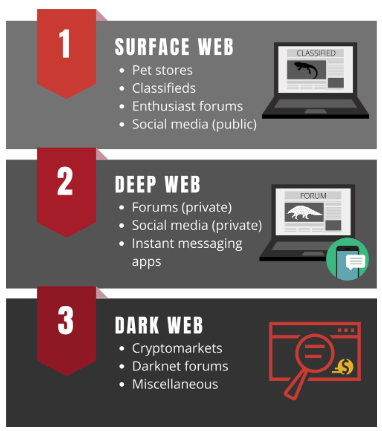
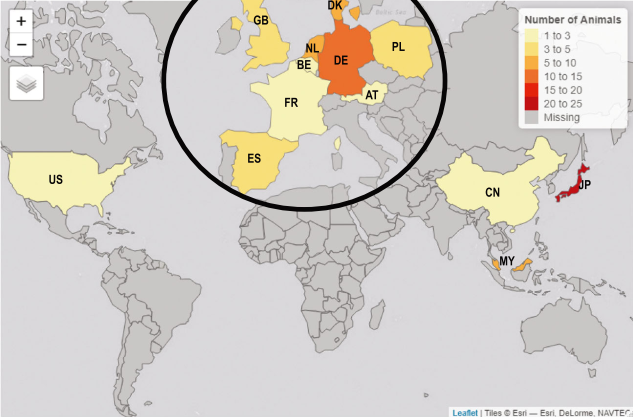
Strengthening protection of endemic wildlife threatened by the international pet trade: The case of the Australian shingleback lizard

Australian reptiles face serious conservation threats from illegal poaching fuelled by international demand and the exotic pet trade. We investigated the extent of illegal trade in a charismatic Australian lizard: the shingleback, also known as the bobtail or sleepy lizard. Using government records, media reports, and online advertisements, we found clear evidence that many shinglebacks have been illegally poached from the wild and are smuggled overseas to be traded as pets. Not only are our findings concerning from a conservation and animal welfare perspective, but they also highlight a major legal loophole. Once shinglebacks are illegally smuggled out of Australia, there are no legal actions available to prevent or regulate overseas trade. To address this, we recommend using an existing and under-utilised legislative tool (Appendix III of CITES, an international treaty) to protect Australian shinglebacks and help to curtail global trade.
By Sarah Heinrich, Adam Toomes, Chris R. Shepherd, Oliver C. Stringham, Matt Swan, Phillip Cassey in Research

July 5, 2021

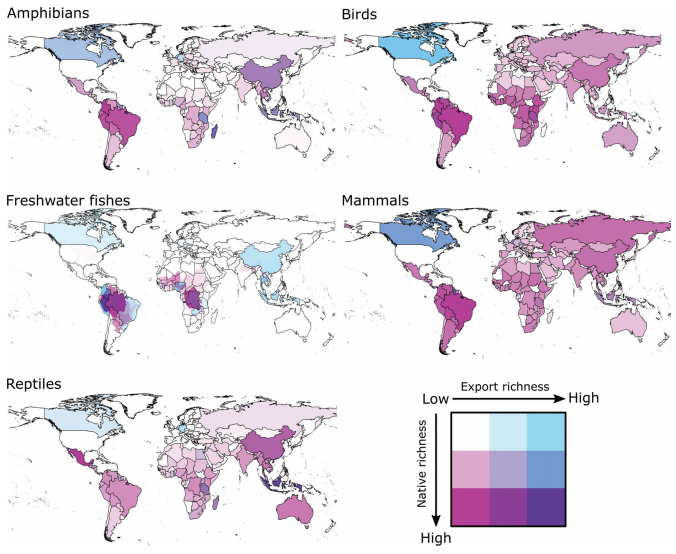
The International Vertebrate Pet Trade Network and Insights from US Imports of Exotic Pets

The international trade in exotic vertebrate pets provides key social and economic benefits but also drives associated ecological, ethical, and human health impacts. Here, we represent and review the structure of the pet trade as a network composed of different market actors (nodes) and trade flows (links). As a case study of how data-informed networks can realize this goal, we quantified spatial and temporal patterns in pets imported to the United States. Our framework and case study illustrate how network approaches can help to inform and manage the effects of the growing demand for exotic pets.

By James S. Sinclair, Oliver C. Stringham, Bradley Udell, Nicholas E. Mandrak, Brian Leung, Christina M. Romagosa, Julie L. Lockwood in Research

June 9, 2021

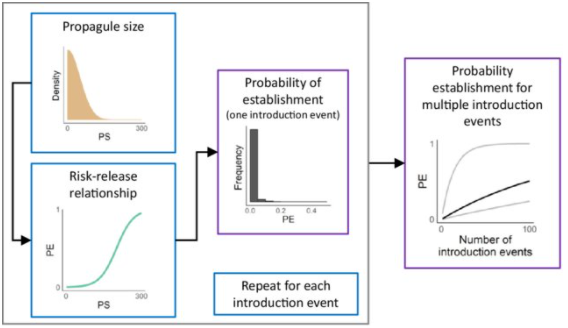
Managing propagule pressure to prevent invasive species establishments: propagule size, number, and risk–release curve

Keeping propagule pressure low can reduce the probability a non-native species will establish in a new location. Here we develop a mathematical framework that can determine the required reduction in levels for propagule size and number (representative of management actions) to maintain a target establishment probability. Our tool can serve to guide the development of new invasive species management plans in a transparent and quantitative manner. Together with information on the costs associated with approaches to reducing propagule pressure, our tool can be used to identify the most cost‐effective approach to prevent invasive species establishments.

By Oliver C. Stringham & Julie L. Lockwood in Research

February 26, 2021

A guide to using the Internet to monitor and quantify the wildlife trade

The internet is a vast source of wildlife trade data. Here, we present an accessible guide for Internet‐based wildlife trade surveillance, which uses a repeatable and systematic method to automate data collection from relevant websites. Our guide is adaptable to the multitude of trade‐based contexts including different focal taxa or derived parts, and locations of interest.

By Oliver C. Stringham, Adam Toomes, Aurelie M. Kanishka, Lewis Mitchell, Sarah Heinrich, Joshua V. Ross, Phillip Cassey in Research

December 5, 2020

Response to the Department of Agriculture, Water and the Environment’s ‘Import risk review for psittacine birds from all countries’

We provide comments to The Department of Agriculture, Water and the Environment on their ‘Import risk review for psittacine birds from all countries’ draft report. Due to serious key omissions, we do not support the import of psittacine birds based on the evidence provided in the risk review. The report does not provide sufficient transparency, nor evidence-based assessments of all benefits, risks, or associated costs, of allowing the import of psittacine birds. If the Department wishes to pursue this assessment, then future risk reviews must include the associated costs of facilitating new invasive species, and provide justification on the broader societal benefits of allowing import of psittacine birds. It is our professional scientific opinion that the benefits of importing psittacine birds are outweighed by the significant damages caused by the potential introduction of new invasive species.

By Katherine Hill, Phill Cassey, Oliver C. Stringham, Adam Toomes in Report

September 18, 2020